
What GCs Get Wrong About Low-Voltage Rough-In Timing
Low-voltage gets scheduled last, after the ceiling cavity is already full. Here's what actually goes wrong, and how one bad rough-in cost us 3x the time on a real job.
Most schedule delays we see on commercial projects aren't caused by anything dramatic. They're caused by one trade showing up too late to fit into the space that's left.
Low-voltage — structured cabling, security cameras, access control, fire alarm — is usually the trade that gets treated this way. It gets scheduled last, after the trades everyone thinks of first, and by the time it shows up, the ceiling cavity is already full.
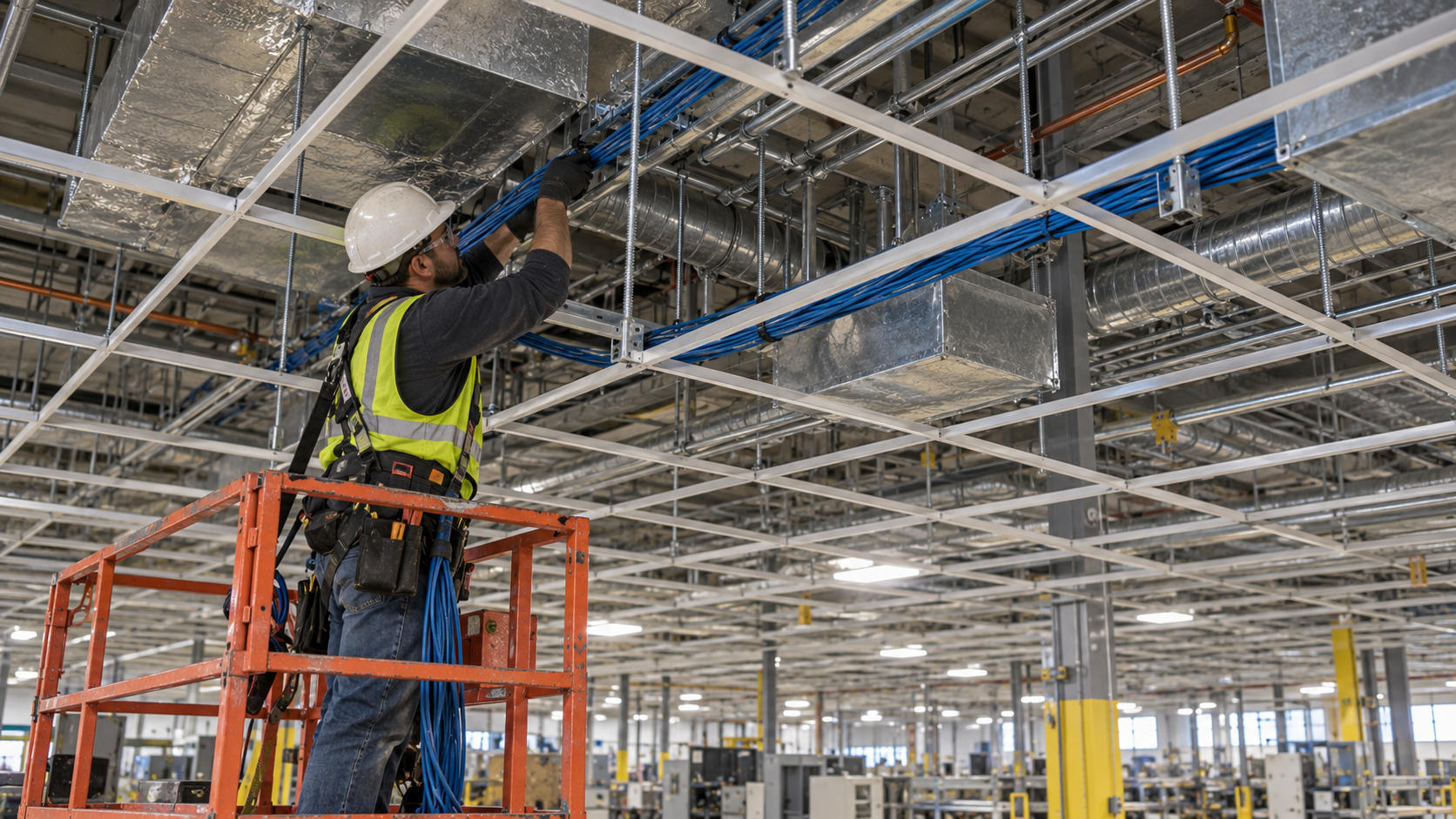
We saw this firsthand on a project at a manufacturing facility we worked on. We were supposed to be scheduled in alongside electrical, running our cable at the same time theirs went in. But because the electrical contractor's scope didn't include the low-voltage piece, we got pushed back — after most of the ceiling grid was already in place. What should have been a straightforward run turned into cable routing around a grid that was never built with our pathways in mind. It took three times as long as it should have.
Here's what actually goes wrong, and how to avoid it.
Rough-In Happens Before Drywall — Not After
Low-voltage rough-in — running cable through open walls and ceilings before they're closed up — needs to happen alongside electrical rough-in, not after it. If low-voltage gets treated as a finishing trade and scheduled post-drywall, the cable either doesn't get run at all before the walls close, or it gets crammed in through whatever access points are left, which usually means more time, more cost, and a messier install than it needed to be.
Ceiling Space Is Contested Real Estate
HVAC ductwork, plumbing, electrical conduit, and structured cabling all compete for the same limited space above the ceiling grid. When low-voltage is the last trade scheduled, it's also the last trade to get a say in where its cable actually goes. That usually means routing around obstacles that didn't need to be obstacles, awkward pathways that look bad in an exposed-ceiling design, or in the worst cases, routes that don't actually meet code — particularly plenum-rated cable requirements in spaces shared with HVAC return air.
Pathways Belong in the Bid Documents, Not Improvised on Site
If dedicated cable pathways aren't specified in the original architectural plans, the low-voltage sub ends up figuring it out in the field, on the fly, after everyone else has already claimed the good routes. Specifying pathway requirements up front — before bids even go out — avoids this entirely.
"It's Just Cable" Isn't True
Low-voltage cable has real physical constraints most GCs outside the trade don't think about: bend radius limits, required separation distance from electrical lines to avoid interference, and fire-rating requirements in certain spaces. Scheduling that assumes cable can just be routed anywhere, whenever, tends to run into exactly these constraints at the worst possible time — mid-install, not during planning.
Certification Should Happen Before Walls Close, Not at Punch List
Copper and fiber certification testing is cheap and fast to do while everything is still accessible. It's expensive and slow to discover a problem during final walkthrough, when fixing it means reopening a wall that's already finished.
The Simplest Fix: One Sub Instead of Two
A lot of this gets easier when structured cabling, security, access control, and fire alarm are all handled by the same subcontractor. That's one trade needing ceiling access instead of two, one schedule to slot in instead of two competing windows, and one point of contact if something needs to be adjusted mid-project.
The manufacturing facility job is exactly the scenario this solves — if low-voltage had been part of the electrical scope from the start, or scheduled as its own coordinated trade early rather than an afterthought once electrical wrapped, that ceiling grid would have had a place for our runs before it ever went up. That's exactly why we added fire alarm to our scope too — not to grow for its own sake, but because splitting low-voltage and life-safety across two separate subs creates exactly the kind of scheduling friction this post is about.
Aegis Digital Networks bids and installs structured cabling, security systems, access control, and fire alarm across Northeastern Pennsylvania. If you're building out your subcontractor list for an upcoming project, call (570) 464-8771.
Ready to get started?
We serve businesses across Scranton, Wilkes-Barre, Hazleton, and all of Northeastern Pennsylvania. Request a free, no-obligation walkthrough today.